
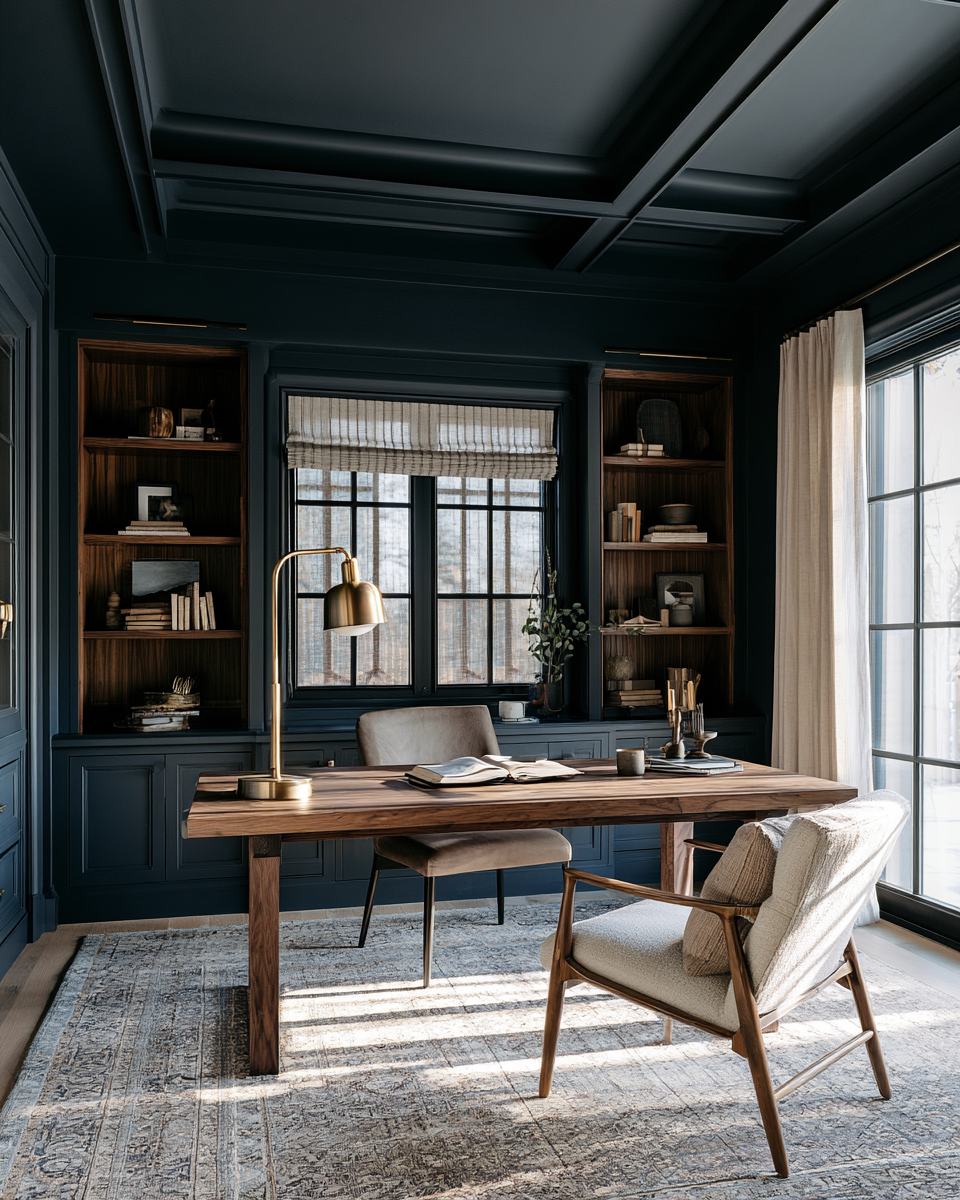
There’s a version of a home office that feels like a penalty box — a spare bedroom with a folding table and a floor lamp from 2009. And then there’s the version we’re here for: a space that’s considered, calm, and quietly beautiful. A room that signals to your brain, this is where good work happens.
Whether you’re starting from scratch or helping a client rethink an underperforming space, these 14 home office ideas span paint, wall treatments, layout strategies, and styling details that elevate the room without overwhelming it.
1. Commit to a Dark, Moody Paint Color

One of the most transformative things you can do in a home office is go dark. Deep inky tones — think a charcoal with blue undertones, a saturated forest green, or a warm espresso brown — create a sense of enclosure that actually supports focus. Unlike bright white rooms that can feel clinical and scattered, a moody office wraps you in a sense of intention.
Designer’s tip: Paint the ceiling the same color as the walls, or go one shade deeper. It turns the room into a cocoon rather than a box.
Colors to explore: Farrow & Ball’s Hague Blue, Benjamin Moore’s Black Ink, Sherwin-Williams’ Cascades.
2. Try Limewash for Texture and Depth

If flat paint feels too expected, limewash is your answer. Applied in irregular, layered strokes, it creates a soft, aged effect that reads as both organic and deeply sophisticated — right at home in Japandi, organic modern, and Mediterranean-leaning aesthetics.
Limewash is particularly beautiful on a single accent wall behind the desk, where it becomes an ambient backdrop that’s interesting without demanding attention. Because the texture is built into the finish itself, you don’t need much else on that wall.
To try: Portola Paints Classico Limewash in a warm greige, or a chalky blush.
3. Install Grasscloth or Woven Wallcovering

Texture is what separates a designed space from a decorated one. Grasscloth wallcovering — or any woven natural fiber wallpaper — adds tactile warmth and acoustic dampening that paint simply cannot achieve. In a home office, that subtle sound absorption is genuinely functional.
Install it on all four walls for full immersion, or limit it to the wall your desk faces for a grounded, gallery-like effect. Either way, pair it with warm-toned wood furniture to let the natural materials speak to each other.
4. Use Paneling to Add Architecture

Rooms that lack architectural character get it fastest through wall paneling. Board and batten, Shaker-style raised panels, or simple vertical planks all add height, rhythm, and a handsome sense of craft to a plain room.
For a home office, consider paneling the lower two-thirds of the wall (with a chair rail as the dividing line) and painting it a contrasting color — a warm white panel below a deep sage wall, for example. The layering gives the room visual complexity without clutter.
5. Lean Into Built-In Bookshelves

Nothing says serious, beautiful home office like built-in shelving flanking a window or fireplace. Beyond their obvious storage utility, built-ins add the kind of permanence and custom-feeling architecture that makes a room feel truly considered.
If custom millwork isn’t in the budget, IKEA Billy bookcases with added trim and a coat of paint are a well-established designer workaround. The key is to style the shelves with intention: a mix of books (spines alternating out and in), objects, plants, and a few empty pockets of breathing room.
6. Float the Desk Away from the Wall

One of the most common home office layout mistakes is pushing the desk flush against the wall so the person working stares at paint all day. Instead, float the desk into the room — facing the door, angled toward a window, or centered in the space.
This single layout shift changes the entire feel of the room. You’re working in the space rather than cornered by it, and the desk becomes a design moment rather than an afterthought.
Who this works for: Rooms with enough square footage that the desk doesn’t block traffic flow when pulled away from the wall.
7. Layer In a Statement Light Fixture

The overhead light in most home offices was chosen by a builder in 2003. Replace it. A statement pendant or chandelier above the desk does double duty: it provides better, warmer light than a flush ceiling mount, and it gives the room a vertical focal point that pulls the eye upward.
For an organic modern or Japandi space, look for rattan pendants, sculptural paper lanterns, or minimalist arc lamps. For something more traditional or Mediterranean-influenced, a forged iron chandelier or antique brass pendant reads beautifully against dark walls or exposed wood beams.
8. Create a Gallery Wall That Doubles as Inspiration

The wall facing your desk is prime real estate. Rather than leaving it blank (visually cold) or filling it with a single large print (often feels timid in a high-ceiling room), build a gallery wall that reflects the client’s taste and aesthetic world.
A well-curated gallery wall could include architectural prints, vintage maps, pressed botanicals, black-and-white photography, or original art. The scale doesn’t need to be uniform — mixing frame sizes and types creates interest — but a cohesive palette ties it together.
9. Add a Reading or Lounge Chair

The best home offices aren’t only about the desk. Including a comfortable chair — a proper upholstered armchair, not an extra desk chair — creates a secondary zone for reading, calls, thinking, or simply switching postures midday.
Tuck it into a corner with a good floor lamp and a side table, and you’ve created a room with genuine versatility. From a design standpoint, the chair also softens the functional geometry of the desk and shelving, making the whole space feel more livable.
10. Incorporate Wainscoting for Subtle Elegance

Wainscoting — traditional paneling applied to the lower portion of the wall — lends a sense of historical weight and refinement that’s quietly impressive in a home office. It’s especially effective in rooms with high ceilings, where the lower-wall treatment anchors the space.
Classic raised-panel wainscoting reads traditional; flat-panel or beaded-board wainscoting skews more casual and coastal. Either way, painting it in a tone that harmonizes with (rather than matches) the upper wall color creates a richer, more layered result.
11. Don’t Overlook the Ceiling

The ceiling is the most underused surface in interior design. In a home office, a treated ceiling can transform the entire mood of the room. Options to consider: painted a contrasting or complementary tone, clad in warm wood planks, finished with a subtle grasscloth, or fitted with exposed beams (real or faux).
Even simply painting the ceiling a deeper shade than the walls creates a more intimate, grounded feeling — particularly effective in home offices where the goal is focus rather than expansiveness.
12. Ground the Space with an Oversized Rug

In a home office, a rug serves both acoustic and aesthetic functions. Acoustically, it reduces echo and creates a quieter working environment. Aesthetically, it defines the desk zone, adds warmth underfoot, and ties the furniture together into a cohesive composition.
The most common mistake is going too small. A rug in a home office should extend at least 18 inches beyond the desk on all sides, large enough that the chair can roll back without leaving the rug entirely. Natural fiber rugs (jute, sisal, wool) work beautifully in organic and Japandi-influenced offices; a vintage or vintage-style flatweave adds character to a more eclectic or Mediterranean aesthetic.
13. Style the Desk Like a Still Life

The desk surface is a micro-environment. When styled with care, it signals calm and order — which translates directly into how it feels to sit there and work. The goal is not a sterile surface, but a considered one.
Keep to a tight edit: a quality desk lamp, one or two small objects with meaning (a stone, a handmade vessel, a single framed photo), a small plant, and a beautiful notebook. Matching desk accessories in a single material — brushed brass, matte ceramic, aged leather — pull it together without effort.
14. Use Curtains to Add Softness and Scale

In a home office, window treatment is often the last thing considered and the first thing noticed when it’s missing. Long, floor-to-ceiling curtains in a natural linen or textured fabric soften the hard lines of furniture and shelving, add warmth to cooler-toned rooms, and — when hung above the window frame — make ceilings feel taller.
For a Japandi or organic modern office, choose unlined linen in oat, flax, or warm white. For a more dramatic, moody aesthetic, go with a deeply colored velvet or a subtle pattern that echoes the wall treatment. Either way, mount the rod as close to the ceiling as possible. The visual impact of that decision alone is significant.
The Takeaway
A home office that’s been intentionally designed doesn’t just look better — it functions better. Attention to paint, wall treatment, layout, light, and texture compounds into a room that supports concentration, signals professionalism, and makes you genuinely glad to be there.
The best home office isn’t the most expensive one. It’s the one that was thought about.
